Can a learner make an informed choice?
A learner needs enough information to choose a suitable offering, rule one out or ask for help. This assessment follows those decisions through search, details and the registration or inquiry handoff.
October 26, 2026: bounded expert assessment. The four working situations in the research and needs comparison are considered below. The sponsored learner's route remains open after its public funding note. Asking before commitment is a fifth, cross-cutting check. These are review tasks, not participant accounts or validated personas. All prices, dates and claims below are displayed prototype values with unconfirmed data origin. The findings hold the recommended changes; screenshot comments hold the short marker text.
1. Arriving with a known offering
Goal: confirm a recommended healthcare offering and understand whether to proceed. The task uses the earlier CNA search and Health Care Assistant at SUNY Adirondack. Referrals and known-offering entry are supported review situations in R01 and the adjacent R03; their frequency here is unknown.
| Decision | What the interface supports | What still needs clarification |
|---|---|---|
| Is this relevant to my goal? N-003 | CNA search returned Health Care Assistant. The description names patient-care work and concrete skills. | What completion itself awards versus a separate certification step. The award section mixes a digital badge and exam preparation. |
| Can I attend? N-001 | Campus, location, age minimum, date ranges, meeting days/times, one closed section and an available section are shown. | Any learning commitment beyond listed meetings. A complete entry/prerequisite policy cannot be inferred from the age minimum alone. |
| Can I afford it? N-002 | A $1,475 estimate and conditional aid message are shown. | Included costs, final payable amount and the appropriate aid confirmation step. |
| What happens next? N-004 | The campus dialog names SUNY Adirondack, explains the new window and provides contacts. | Whether a chosen section or other context carries across, and how records/support work afterward. These are owner questions. |
| Can I ask first? N-005 | Campus phone/email are displayed without entering an account. | No inquiry form or response time was established; no message or call was made. |
Judgment: the page supports an initial suitability check and an explained campus handoff. It does not yet support a confident conclusion about the final cost or exact credential/certification outcome. Preserve the campus identity and contacts; clarify those decisions before stronger registration prompts. E-028, source and screen; F-021, F-023 and F-025.
This CNA task began with search. A separate fresh-session check opened the direct link to Old Westbury's Conversational Spanish I without using search first. It loaded the title, owning campus and Register action. That establishes one working shared-link entry, not expired-link behavior or the direct route for every offering. Fresh browser check; stable-link rule, S03 story 35.
2. Exploring patient-care training around existing commitments
Goal: compare options for work involving patients, including whether attendance is practical. This is a proposed task, not a claim about a particular learner's work hours or intended profession. The basis is practical fit and differing work/study goals in F-013–015 and F-017.
Searching patient care returned 20 displayed results, including clinical, office and other healthcare topics. Starting with a broad goal is possible. The page is sorted by start date and does not explain suitability for a particular job; no recommendation engine is assumed. Two plausible candidates were opened and compared:
| Displayed fact | Health Care Assistant, Adirondack | Clinical Patient Care, Broome |
|---|---|---|
| Learning context | Personal/home/nursing care described; specific patient-support skills | Medical-office/ambulatory clinical functions described |
| Duration and credit | Two semesters; eight credits | One semester; seven credits |
| Delivery | Face to face, Queensbury | Hybrid, Binghamton |
| Meeting times | Monday/Thursday, 3–5:30 p.m. | Monday/Thursday, 9–11:30 a.m. |
| Shown estimate | $1,475 | $2,225 |
| Outcome wording | Digital badge plus separate exam-preparation entry | Digital badge; description discusses further learning and exam preparation |
| Next route | Named campus-registration dialog | Named campus-registration dialog with campus contact |
The pages give enough detail to identify different schedules, locations, costs and learning contexts. They do not establish equivalent qualifications or guarantee either is suitable for a given job. Broome's full description was checked visually because accessibility snapshots shorten long text.
Judgment: a visitor can compare important differences after opening details, and can reject an option whose meeting times do not fit. Result cards show start date and semester length but omit the recurring meeting times needed for that early comparison. Broome's Hybrid label does not explain which sessions require travel or happen online. Total study hours, final cost and verified outcomes also remain uncertain. Improve these decision facts before adding personalization or a large comparison feature. E-045 search; E-046 Broome details; E-047 handoff. F-021, F-023, F-025 and F-029–030.
3. Learning Spanish for travel or personal value
Goal: find an appropriate introductory conversation course and judge its time, level and cost. Personal/family/community interests are supported as review questions by F-016, with indirect evidence from different learner populations. They do not establish who uses this catalog.
Spanish search returned 13 displayed results, including conversational and work-specific offerings. Conversational Spanish I explicitly describes travel, work and community uses. A visitor can follow related links to the same named course at other campuses.
| Displayed fact | SUNY Cobleskill | SUNY Old Westbury |
|---|---|---|
| Delivery | Face to face | Online |
| Duration | One semester; 25 instruction hours | One semester; 50 instruction hours |
| Recurring meeting time | Wednesday, 1–2:40 p.m. | Monday/Thursday, 9–10:40 a.m. |
| Shown estimate | $465 | $650 |
| Stated outcome | Completion certificate; separate possible credit pathway | Completion certificate; separate possible credit pathway |
Judgment: the content allows personal learning to be the reason to attend. Fixed online meeting times are visible in details, so online is not presented solely as a self-paced promise. But the brief learning description does not state required prior knowledge or concrete conversational abilities on completion. The same title and semester label also conceal a difference in teaching hours until details are opened. A learner needs those facts to judge level and value. Potential credit and employer funding can remain conditional information, with less emphasis for someone who does not need them. E-032 Cobleskill; E-048 Old Westbury; E-049 search. F-023 and F-030–031.
The Old Westbury Register action was not activated. The earlier Rockland workshop established a cart handoff; that result must not be claimed for every course without checking its actual route.
4. Interested but not ready to register
Goal: resolve an unanswered question or recover when a search has no result. Public inquiry before an account/registration is supported by FRD section 4.2.2 and catalog use cases; May feedback also treated questions as a route before commitment. Requirement notes; May 21.
On the healthcare pages, a learner can find the responsible campus's phone/email beside the next step. Broome's Information / Register opens a registration dialog that repeats those contacts; it is not a submitted information request. That distinction should stay clear.
On the checked workshop and Spanish detail pages, the observed alternatives include campus website links and a general Contact SUNY footer link. A course-specific question action was not found in those states. The glassblowing empty-search Contact Us showed no visible response after both direct pointer and keyboard activation.
Judgment: help is uneven across the checked paths. Preserve the healthcare campus contacts. Give other offerings an approved course-specific help route and repair empty-search recovery. The owner must confirm where questions go, what context carries and any response promise. E-033 empty-search recheck; E-047 healthcare contacts; workshop detail; Spanish detail. F-024 and F-032.
The inquiry form itself was not reached. S03 story 37 calls for a public course/section question without an account; May 22 refined course-context and campus-specific tuition-reimbursement copy. Required fields, acknowledgement, routing and the response promise remain open. This is a check for the support owner, separate from the observed empty-search Contact Us failure. Story; May 22 follow-up.
5. Joining arranged training
Goal: a learner referred or sponsored by an employer checks that the course, worksite and schedule fit, knows who pays, and reaches the correct personal next step. The working scenario makes this distinct from employer administration. R01 and R03 support referred entry only indirectly; SUNY's audience size is unknown.
The Rockland workshop says employees of a participating employer may qualify for tuition assistance and should ask their employer before registering. It shows the usual $135 estimate and Register action. The page does not establish whether a sponsored learner pays that amount, uses the public cart, receives an invitation or is linked to an employer after entry. The draft requirements describe cohort checks of seats, schedule, worksite and cost, and allow an employer to be billed later. Employee-to-employer linking remains unresolved. Workshop funding; S10 employer rules.
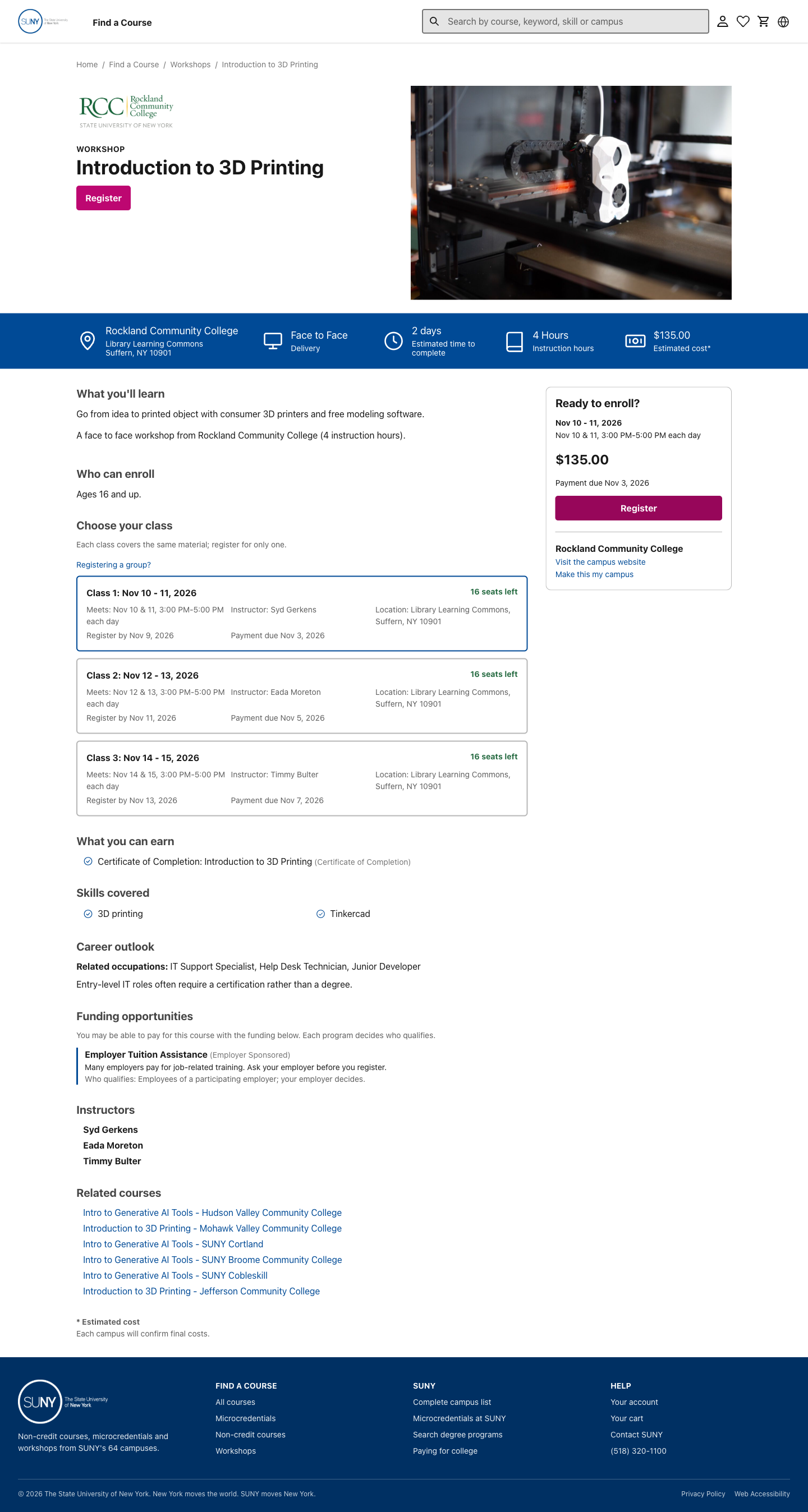
Judgment: the funding note is a helpful warning to ask first, but the learner's own sponsored route was not exercised. PruTech and the SUNY/employer owners need to define when the public path applies, which offer the learner is meant to join, who confirms eligibility and payment, and what the learner must do. Keep the employer's group-management screens outside this public review. F-049.
Responsibilities and access across these scenarios
N-006 applies when a learner is referred, sponsored or helped. Generic quantity/gift controls do not establish a supported group-registration process. May 21 also raised a different case: one person choosing two courses at the same campus. One stakeholder supplied that account; its prevalence and current cart support remain unknown. Full employer and guardian workflows remain outside this assessment; a learner must not be treated as authorized to act for another person by default. May 21 discussion; F-026.
The known-offering page includes a closed section and an alternative section with seats shown. A separate coming-soon/full/waitlist journey was not established. Filters, return context and clear-all work in the sampled catalog. Saving a preferred campus put its courses first without removing other campuses; declining device location offered manual ZIP entry. The actual distance results and teaching-site rule remain unchecked. A Spanish catalog loaded, but its skip link stayed in English; the full translated journey and agreed language count need checking. One Buffalo State microcredential detail was inspected, including its age line and outcome wording. A parent program with child offerings was not. Fresh browser evidence; F-046–050.
At 320 pixels, clipping limits access to catalog controls and comparisons; at 390 pixels, selected modal/filter-panel keyboard checks were useful. Later Chromium checks confirm low-contrast search hints, missing focus on the sampled Register action and a breadcrumb hidden by the fixed header. See F-038–040 and E-061/062 in the main review. Actual 200% browser zoom was sampled in E-064; physical phones, full keyboard/screen-reader coverage, complete zoom behavior and unavailable-state coverage remain untested.
What the review now supports
The common design problem is helping people judge attendance, cost and outcome before choosing the next step. Differences call for relevant details: clinical versus personal learning goals, live versus flexible study, and individual versus sponsored responsibilities. The evidence supports a shared structure with conditional information, not a page per draft persona.
Recommended redesign focus: the results-to-detail-to-handoff part of the authorized journey. Show decision facts early, explain learning outcomes and delivery clearly, and keep registration and asking for help understandable. Preserve working filters, class summaries and named campus handoffs. Product choices about routes, release scope and data ownership remain conditions for final design decisions.
This bounded expert pass addresses all four working situations and the additional help case, with the sponsored route explicitly left for an owner-backed walkthrough. It provides a basis for design exploration, with open checks above. Learner comprehension and task success have not been measured. Use realistic tasks with relevant learners to test these judgments before claiming the redesign helps.
Recommended design direction
RD-001, October 26: direction to check in the working prototype. Help people compare practical fit in results, then use a shared course-page structure to answer attendance, cost, outcome and next-step questions. Before changing screens, trace the review notes to the repository and check which content and components already support them. SUNY learners have not tested this direction.
Approaches compared
| Approach | What the learner experiences | Main tradeoff | Judgment |
|---|---|---|---|
| Refine the current layout | Familiar image-led cards and detail pages, with clearer labels, repaired controls and stronger readability | Leaves recurring meeting times and teaching hours mainly inside details, so comparison still needs repeated page visits | Useful corrections, but does not fully address F-030 and F-034–037 |
| Bring decision facts forward | Results expose attendance and cost consistently; details explain learning, entry conditions, class choices and the next step | Needs reliable content and careful grouping so results stay readable | Recommended: addresses the shared needs while preserving direct entry and browsing |
| Add a guided course finder | Optional questions help an unsure visitor narrow choices before opening results | Needs evidence about useful questions and dependable course-to-goal mappings; can delay visitors who already know what they want | Keep as a later possibility, not the main entry route |
All three approaches require accessibility repairs. A simpler appearance alone would not resolve the keyboard and narrow-screen findings.
Why the second approach: actual comparisons found important differences behind similar labels: 25 versus 50 Spanish teaching hours, set online meetings and unexplained hybrid attendance. The learner studies support asking about practical fit; these observed states identify where the current pages leave work to the visitor. No evidence establishes one decision order for every learner. Keep the key facts together and use clear headings to support different starting points. N-001–006; F-021–025 and F-029–040 in Findings.
What the recommended journey would show
| Place | Proposed change | Support and dependency |
|---|---|---|
| Results | Keep search, selected filters and return context. Give campus, format, date range, recurring meetings, teaching hours and listed cost a predictable order. Avoid letting images crowd out these facts | N-001–003; F-030/F-036; R09/R11/R14. Confirm which facts are available in result data. Do not infer that missing meetings mean self-paced |
| Course details | Lead with the course, owning campus, useful learning outcome and a compact attendance/cost summary. Reduce decorative space. Make entry conditions and class choices easy to reach | F-021/F-029/F-031/F-034–037. Campus owners must confirm outcomes, prerequisites and hybrid details |
| Class selection | Preserve the selected class and its matching summary. Keep meeting time, location and deadlines distinct. Explain what is unknown about cost | N-001–002/N-004; F-023 and the working workshop summary. Do not invent fees, late-payment rules or a seat hold |
| Next action | Use a label that describes the verified route. For the observed workshop cart route, propose “Add selected class to cart.” For an external route, explain the named campus handoff | F-025–026. PruTech and SUNY must confirm the release model before applying routes to other offerings. Stop before account, reservation or payment |
| Help and recovery | Make course-specific help available before commitment; preserve known campus contacts. Empty results should retain the query and offer useful changes or a working help route | N-005–006; F-024/F-032. Confirm the receiving team and supplied contact details. Do not invent a response time or submission service |
Use one clear treatment for the main action, with distinct navigation, supporting actions and selected states. Keep existing institutional identity while the project palette is unconfirmed. Text contrast, visible focus, focus below the header, a layout that fits narrow screens and readable enlarged text are part of the design. Visual/access evidence and criteria.
Keep future changes grounded
Use the observed Spanish comparison to show personal learning and concrete schedule/hour differences. Check the same structure with the two observed healthcare offerings and the workshop, so it also handles hybrid attendance, credential questions, class choice and both handoffs. This is one shared discovery-to-handoff journey, not several separate redesigns. Do not call the healthcare courses equivalent or imply that cheaper Spanish provides the same learning.
Prices, schedules and awards remain displayed prototype values until their source is confirmed. Missing essential content must stay visible as an unanswered question. Separate campus-owned data corrections from presentation changes; confirm actual source fields and component support with PruTech before claiming implementation feasibility.
What would change this recommendation
Reconsider a guided finder if relevant learners repeatedly cannot turn their goal into a useful search and the team has reliable mappings to support the questions. Reconsider the amount of information in results if testing shows it obscures comparison. Keep the information available through a clear route. Owner confirmation may change the action and handoff, without removing the need to explain them.
How to check the direction
Before claiming improvement, check whether relevant learners can:
- Compare Spanish meeting times and teaching hours, and rule out an option that does not fit.
- Explain hybrid attendance, or identify that the campus still needs to clarify it.
- Distinguish a listed cost from a confirmed total, and a completion award from a separate exam.
- Predict the next action and find the right campus help without registering.
Keep the original captures as the expert-review baseline. No learner success rate or time benchmark exists. Use comparable tasks with careful handling of prior exposure when checking the redesign. Test the implemented interactions by keyboard, at 320/390 pixels, at actual 200% browser zoom and with spacing overrides. Screen-reader and relevant error/status checks are also needed. A well-informed decision not to enroll can count as success.
The shared web app currently presents the review and journey map. Ask PruTech for access to the working prototype repository, then map the review notes to its pages, data and components. Agree targeted fixes with the team before changing the product. No redesigned artifact is being presented at this stage.